Climate science, based on over two centuries of knowledge, demonstrates that anthropogenic CO2 increases lead to global warming. "It is unequivocal that human influence has warmed the atmosphere, ocean and land" (IPCC, AR6, 2021). This scientific consensus rests on proven physical formulas and thousands of published scientific articles.
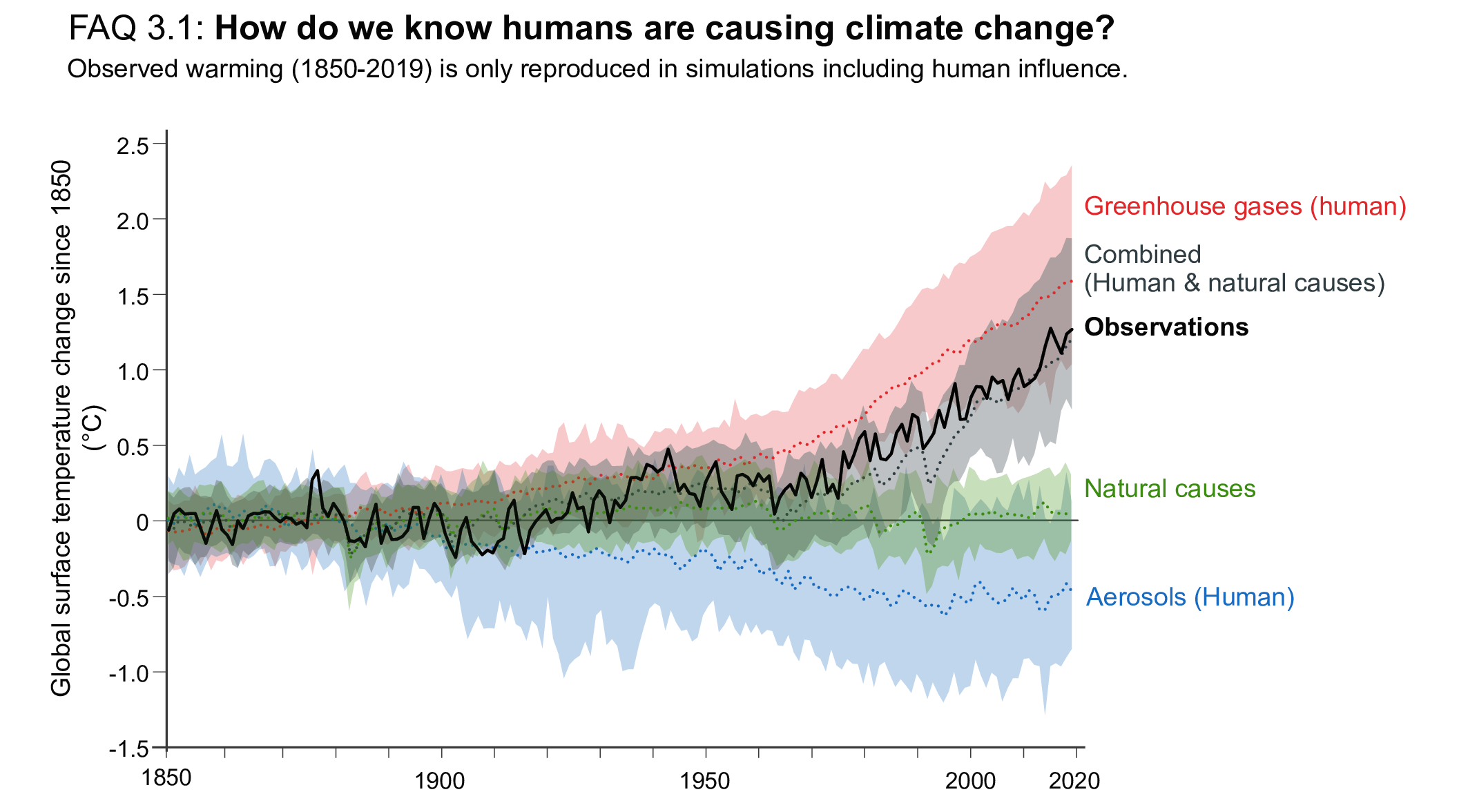
Different mechanisms influence the climate:
Humans are the primary cause of recent climate changes, mainly due to the increase in GHGs and aerosols resulting from their activities. Climate models only reproduce observed warming when they include human influence, confirming that natural processes cannot explain it. The current rate of warming exceeds that of the last 2,000 years, reinforcing this conclusion.
GHGs, particularly CO2, have increased considerably since 1750, leading to a rise in the radiative balance, and thus temperatures. Unlike water vapor, whose concentration is stable, long-lived GHGs, such as CO2, disrupt the climate system over millions of years, and the continuous addition of GHGs prevents the system from adjusting.
Climate change represents one of the major challenges of our time.
Switzerland experiences Alpine amplification: indeed, due to its distance from the oceans, its topography, and the reduction of albedo (melting of snow and glaciers), it is warming about twice as fast as the global average. MeteoSwiss ("Climate CH2025") notes that in a world at +3°C:
In 2023, Switzerland's GHG emissions amounted to 41.3 million tonnes of CO2 equivalent, representing a reduction of 22.3% compared to 1990.
The main sources of GHG emissions in Switzerland are (2024):
Switzerland is a small open economy closely integrated into global trade. Consequently, it is important to consider not only national emissions but also those generated abroad by Swiss final demand. Given the significant share of imported goods, a large part of the greenhouse gas footprint is generated abroad. In 2023, the territorial emissions mentioned above represented only a quarter of Switzerland's total emissions. In 2023, the GHG footprint per person amounted to approximately 14.8 tonnes of CO2 equivalents. This far exceeds a level compatible with planetary boundaries.
Environmental changes affect all aspects of our societies and our environment. Climate change is not an abstract future risk: its effects are already measurable in Switzerland. For a municipality, it is a matter of understanding how these impacts structurally change the territory. Understanding these impacts means knowing how to adapt projects. These Swiss trends directly impact the sustainability of infrastructures and land-use planning in Vaud. Year-to-year variability will remain strong, but the underlying trend is clear and documented. The 2nd generation Vaud Climate Plan (State of Vaud, 2025:8-9) details their concrete manifestations in the territory.
If fire bans in forests were rare before the 2000s, they are now common and last an average of two weeks each year. Repeated drought phases increase the vulnerability of Vaud forests.
In 2022, the sources of the Venoge, in L'Isle, dried up due to drought and heatwaves. Further downstream, the river flow reached low-water levels (i.e., minimum flows) never seen before. These situations are critical for ecosystems, agriculture, or hydroelectric production.
The multiplication of intense precipitation events increases the quantities of water running off the surface, particularly in urban contexts. Thus, the storm of June 11, 2018, caused significant damage in Lausanne. The record amount of rain flooded underpasses, damaged cobblestone street surfaces, and caused water leaks in certain buildings.
Since 1973, the average annual temperature of Lake Geneva shows, for example, a very marked warming trend between 0 and 10m depth, leading to modifications in the habitats of aquatic fauna and flora.
Health threats are exacerbated by the consequences of climate changes. For example, summer heatwaves, smoke from forest fires, drought, or floods have negative effects on health. In the absence of adequate measures, they can even be fatal for vulnerable people.
Climate changes generate additional stress affecting soil quality and biodiversity, which are already in sharp decline in Switzerland. The situation is critical for many native species: 35% of them are extinct or threatened.
In July 2021, severe bad weather caused flooding of many waterways and the overflow of Lake Neuchâtel, generating significant damage and high costs for communities.
Drought periods generate water stress on plants. For grasslands, these conditions can sometimes lead to a yield decrease of up to 40%. This increases the canton's dependence on the import of agricultural raw materials.
Covered in ice for over 2,000 years, the Tsanfleuron pass, near the Diablerets, resurfaced in September 2022 due to the separation of the Scex Rouge and Tsanfleuron glaciers. Glacier retreat affects the landscape, the geological properties of the terrain, and tourism.
Climate changes, just like certain climate policy measures, pose socio-economic risks on certain categories of the population. These include, on the one hand, possible repercussions on rent, energy, or food costs, and on the other hand, a risk of accentuating certain inequalities due to a lack of resources to adapt to impacts.
Not all municipal projects are equal in the face of climate. Vulnerability depends on three combined factors:
exposure (where is the project located?), sensitivity (what does it depend on?), and adaptive capacity (can it be easily adjusted?).
Adaptation consists of adjusting our natural and human systems to minimize damage or exploit opportunities linked to climate changes. It does not replace the reduction of GHG emissions, but it is indispensable for changes already underway. It is all the more effective when anticipated, as some damage is irreversible.
Comparing climate scenarios (+1.5, 2, 3°C global average) allows evaluating the additional costs and risks for Switzerland if the Paris Agreement goals are not met. Adaptation measures must be flexible and modular to adapt to hotter scenarios, while ensuring transparency on risks and safety. Adaptation to a world at +3°C (i.e., +4.9°C in Switzerland) will require considerable efforts and structural changes.
It is almost always less expensive to prevent than to repair. Adaptation costs are already being borne today in Switzerland — Grindelwald glacial lake drainage tunnel (15 million CHF), permafrost protection dam in Pontresina (7.5 million CHF) — illustrating that inaction also has a price.
Municipalities, the institutional level closest to the population and the territory, play a crucial role in protecting vulnerable populations against heatwaves and natural hazards. They implement prevention and intervention plans to ensure the safety of all. Furthermore, they actively engage in the preservation and strengthening of natural environments, such as waters, forests, soils, and biodiversity, while fighting against invasive exotic species. Managing water supply crises is also one of their priorities. Finally, municipalities integrate climate change adaptation challenges into their land-use planning tools, thus guaranteeing sustainability and resilience.
Climate change mitigation consists of reducing greenhouse gas emissions and strengthening carbon sinks to limit the magnitude of global warming.
The Paris Agreement (2015) aims to:
Switzerland has committed to achieving carbon neutrality by 2050. To achieve this, GHG emissions must be drastically reduced in all sectors. The "Climate CH2025" report confirms that without rapid emission reductions, climate impacts in Switzerland will intensify (heatwaves, droughts, extreme precipitation, etc.).
Key Figures:
The main strategies to reduce emissions include:
Switzerland is part of several international agreements:
The CO2 Act constitutes the main instrument of Swiss climate policy. It defines:
The Energy Strategy 2050 aims to:
Swiss cantons have their own legislation and climate plans, notably:
Municipalities play a crucial role in implementing climate policies:
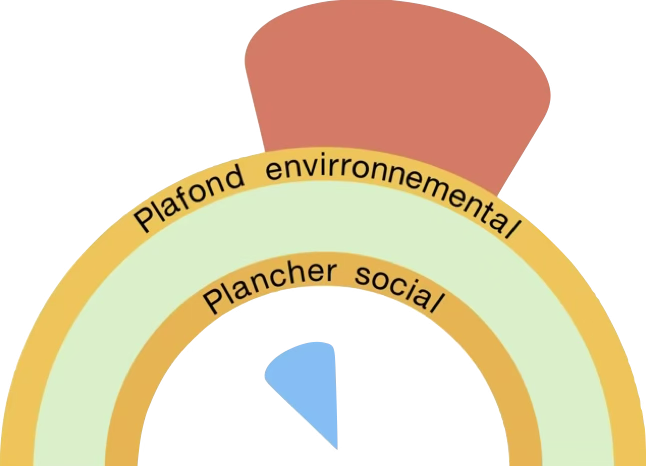
Doughnut Economics is an economic model developed by economist Kate Raworth. It proposes a visual framework in the shape of a doughnut to rethink economics and achieve sustainable and equitable development.
Represents the fundamental human needs that no one should lack:
Represents the planetary boundaries not to be exceeded to preserve ecosystems:
The goal is to live in the space between these two limits: above the social foundation (so that no one lacks the essentials) and below the ecological ceiling (so as not to destroy the systems that sustain us).
The Doughnut model can guide local public policies:
Several cities around the world have adopted the Doughnut approach:
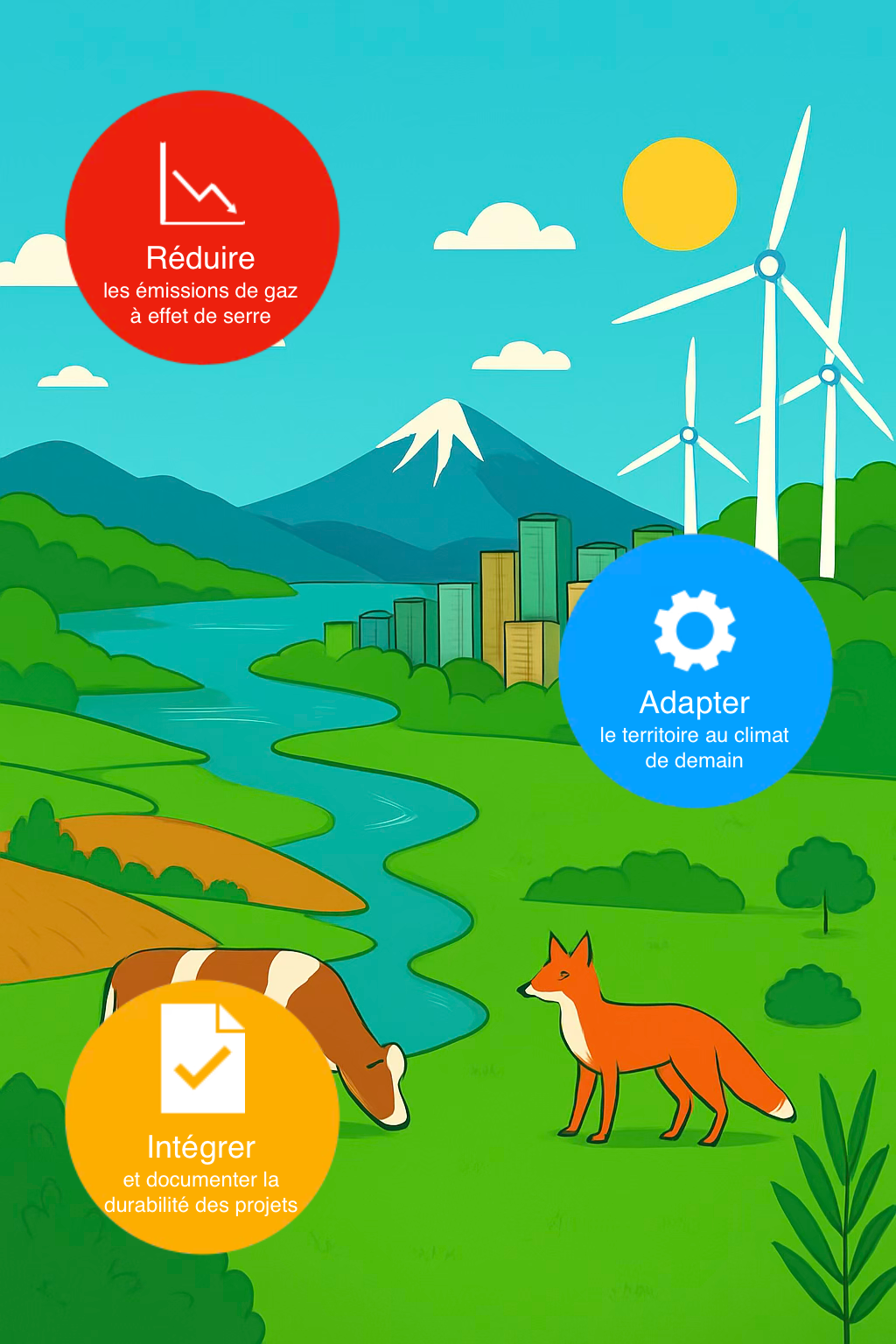
The Boussole 21 tool fits into this logic by evaluating projects according to three interconnected dimensions: